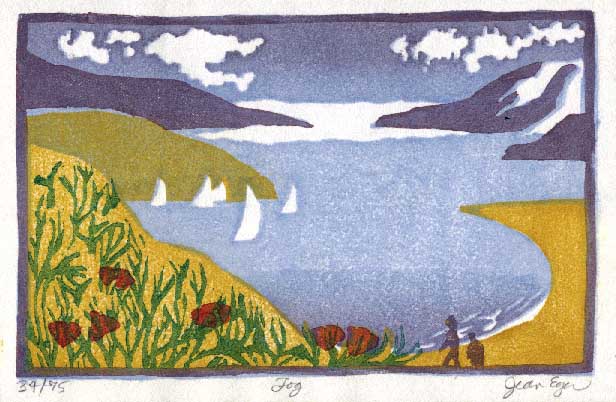
"Where We Live"
etching and aquatint.
Why?
Why am I so interested in printmaking? For years I sold or gave away just about every oil painting or watercolor I made. Every year at holiday time I looked around the house for paintings to give to my loved ones. When I became a printmaker I was able to make editions of prints, usually limited to about 10 to 25 prints of the same thing. Then I could give prints as gifts and still have one for myself! When I re-entered college in 1991, I decided to study printmaking seriously!
My San Francisco State University woodcut instructor replied to my defense of multiples, "The reason people should make prints is because they are so beautiful." She was right about that: each medium has its own special kind of beauty and power: woodcuts and linocuts because they are bold and organic; etchings because of the varied and expressive nature of the marks in the metal; and lithographs because of the silky quality of drawing on limestone combined with their intense and insistent color.
Now my horizons have expanded to include lithographs, etchings and computer prints. The printmaking category of intaglio encompasses etchings, drypoints, aquatints, and mezzotint. Computer printmaking has expanded my printmaking horizons and provided hours of creative enjoyment and mental challenge.
Since studying printmaking at San Francisco State University, I began expressing social concerns, as well as making pretty pictures to sell and give as gifts.
Postgraduate study of Japanese rice-paste-and watercolor wood block printing methods, taught by Katherine McKay, and April Vollmer, increased my desire to teach multicultural printmaking. African printing on cloth and Latin American silkscreen printmaking are also topics which interest me.
However, multiculturalism in printmaking refers to much more than technique. It also refers to the issues that fine art may address, such as identity, ancient symbolism, representation, social and political conscience, language, narrative ethnic history, subject and style. Interviews with two San Francisco Bay Area printmakers highlight these issues.
If you have any suggestions or comments, please e-mail me at email: jeaneger@lanminds.com. I'd love to hear from you!
Getting started with a one color print
![]()
Woodcuts: a beginner's guide
Making a two color print using a separate registration block
Making a two color print using Japanese Kento registration
Getting Started
You will need: 1/2 inch thick piece of wood, about 8 in. by 10 in. preferably pine or birch plywood. You can use linoleum, if you wish, but it is best to buy the stuff specially made for art work, called battleship linoleum. woodcutting tools or linoleum cutting tools....
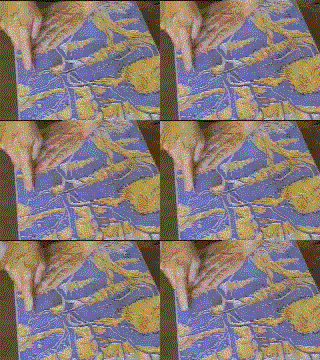
...A woodcutting knife is a tool, not a weapon. Use your woodcutting knives with care and keep them sharp by sharpening them on a stone which you can buy in any hardware store. Watch the position of the woodcutting knife relative to how you are holding your hands. You don't want to cut towards your other hand. That is why this woodcut lesson is not suggested for children under the sixth grade.Here is an animation of one correct hand position. (505K)
You can buy linoleum block cutting tools in a hobby shop or order woodcutting tools from Daniel Smith, Inc., in Seattle. 1-800-426-6740. If you call Daniel Smith they will send you a beautiful free catalog of artist's materials. Utrecht is another good supplier. Utrecht's New York number is 1-800-223-9132. In San Francisco call 1-800-961-9612. THE COMPLETE PRINTMAKER, by John Ross, Clare Romano, and Tim Ross (Collier Macmillan Publishers, London, 1990) contains an extensive list of suppliers' addresses and telephone numbers, including press manufacturers. inexpensive Chinese white watercolor India ink cheap watercolor brush black sharpie pen paper...Almost any paper will work, including copier paper or computer paper. However, a good rice paper is recommended. Mulberry or Hosho are two papers which come to mind. (Mulberry paper was used to create the scanned background for this page.) You can use any kind of paper for proofing. Conservation of natural resources is a real issue here in the United States, so we have to consider that when we choose paper. wooden spoon and/or
![]()
baren (the round rubbing tool covered with a bamboo leaf) plate glass for rolling up the ink brayer rags (for oil-based printmaking turpentine or similar solvent for cleaning up (for oil-based printmaking) shellac(optional, for oil-based printmaking) ink...Speedball inks are most widely available in our area, although other inks are just as good. Check to see if you are purchasing oil-based or water-based ink.
Here's how to do it!
I started out making woodcuts and that remains my favorite medium today. Here's how to do it: you get a nice, flat, scrap piece of pine that isn't all warped, from a lumber yard, or hardware store or neighbor.
Sand the wood if it isn't smooth. That means you might have to go to the hardware store and stare at the different grades of sandpaper wondering which level of grit to use. It depends on how rough the wood is. If the wood is really rough, get a large heavy grit and work your way down to a fine grit. You could ask the salesman (who might also be the owner of the store) and he will tell you if you ask nicely, maybe, if he is not too busy or didn't have a bad day.
Later on when you've been making prints for awhile you can get into birch plywood (it comes in different thicknesses, which may or may not warp), or even Shina plywood which you may have to order from McClain's printmaking supplies in Portland. Actually you can use almost any wood that is flat, including doorskin, which is inexpensive.
Once you have your piece of wood, you can draw on it with a black Sharpie pen (a permanent marker), then cut away everything that isn't black. It works best if you plan large areas of black, instead of tiny, thin, black lines which will be very difficult to cut. In other words, don't try to imitate Albrecht Durer on your first woodcut. If you want to be
neat and precise, you can paint the surface of your wood with thin grey paint--Chinese white watercolor mixed with a little India ink and water. After that dries, draw on it with a Sharpie pen. Then, when you have cut the negative space away, you will be able to see where you have cut.
Otherwise, you can just to draw on the wood with anything you have, then cut away everything that isn't the picture. It's hard to see what you are doing this way, but the results can be exquisitely beautiful.
PRINTING THE PRINT
Now that you have carved out everything that ISN'T your picture, you start the second part of the printmaking process: the printing part. You have to decide whether to use water-based ink or oil-based ink.. Water based inks are easier to clean up, but give different aesthetic results.
Squeeze a dab of ink onto the glass. Roll your brayer over it, so that it spreads the ink evenly on the roller. Roll the brayer horizontally, then vertically. Pick the brayer up at the end of each roll; otherwise you aren't spreading the ink. Roll the ink onto the woodblock. Keep rolling up until the woodblock is evenly coated, but not too much. Place the paper face down onto the block. Once you have placed it, don't move it around. Smooth the back of it with your hand. Rub the back of the paper all over with the wooden spoon. Pick up the paper and take a look. Do you need to use more pressure the next time you print? Do you need to roll up with more or less ink, or more evenly? Do you need to rub more evenly? If you want to check the print while you are rubbing it, you can pick up the corner of the paper with one hand, while holding the other end down with the other hand. That way the paper will fall back in the same place.
Well, that was pretty easy, wasn't it? You should try making different kinds of marks on the wood with the different tools, varying the width of your lines, making patterns of black and white, and making areas of different kinds of textures.
Beauty
Woodcuts which show some of the quality of the wood itself in the print are highly prized. Many printmaking artists respond to Gauguin's prints or the works of Albrecht Durer. These are the artists with whose works I am most familiar, because my cultural heritage is western European. The similar relief process of linoleum block prints (called linocuts) can produce bold and dramatic prints because of the high contrast of black and white, although one can make them in color too. The linocuts of Picasso are also greatly admired here in the United States.
Woodcuts and linocuts are both in the printmaking category called relief. The word "relief" comes from the French word "relever," which means to raise again. In a woodcut, the raised part is the part that prints. Thus, the word "relief" encompasses printmaking methods which print on a raised surface. This word probably has its roots in Latin, as most English words do.
copyright 1995 through 2001 by Jean Eger-Womack
M.A. Creativity and Arts Education, San Francisco State University
B.A. Art, San Francisco State University
A.A. Art, Contra Costa College
Member, California Teachers Association and National Education Association
Member, Phi Delta Kappa, San Francisco State University Chapter
Revised January 19, 2001
email: jeaneger@lanminds.com