Saturday, May 03, 2008

Carb Cleaner is not for long term storage

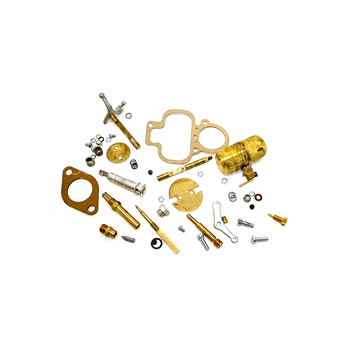
About two weeks ago, I pulled my Tillotson cores out of the tub of toxic methyl chloride carb cleaner. They'd been sitting in there since, oh, last May.

Lots of parts were ruined. Both floats at the very least.

The pot metal pieces looked OK, but the brass parts seemed to have dissociated.

So, yes, let the stuff do it's work, but a month is probably as long as you should let carb parts sit in this witches brew.

Saturday, October 13, 2007

Prop Hubs for VW AeroConversions

A recent kerfluffle on the Sonex newsgroup compels me to take up this matter again.

This post:

VW Cranks (Was Re: Sonex Incident - 9/29/2007)

Frank,
I have sat back too and read this thread on the
VW problems ....part of me just said to keep
quiet .....but the other parts says to share what
you know .....I am no expert but 20+ years of aero
vw use has taught me some stuff ......so here goes;

You hit the nail on the head here. However the VW
with a stock crank and shrink-fit hub works very
well on engines up to 1915cc .....I know because
I have flown behind them for 20+ years, the added
torque of the 2180 increases the risk of failure,
and many of the guys I call experts agree.

I have an Aerovee 2180, I like the looks of it and
I like the package as a whole. When I bought mine
I knew I was going to discard the AeroVee crankshaft
and shrink-fit prop hub!

I immediately sent the block to Steve at Great Plains
and had the block machined for the Force One Prop Hub,
I also purchased his aircraft purpose-built 82mm forged SCAT
crankshaft. It was designed to have the extra
metal in the area of failure, and they have never
had one fail to date. They use it on 2300cc VW's.

There is nothing wrong with the VW, but building a
2180cc engine begins to exceed the strength of the base
engine it's built from. My last 2180cc VW engine had over
1400 hours on it when I sold it ....and it was built by me
from parts I purchased from CB Peformance with the
exception of the crankshaft and prop hub, these came
from GreatPlains!

All my VW engined planes to date were single seat aircraft,
but my SONEX will carry passengers (wife and children) so I
spent the extra money to insure my engine stays together.

Nothing against Sonex / Aerovee, but the VW engine was NOT
designed by them, so they are NOT the last word on anything
VW. They put together a nice package and it's a really
nice engine, but they know of the possible issues with
the VW crankshaft design with a shrink-fit prop hub, they
are aware ....that's why they stress correct prop hub installation,
the Aerovee is not their first use of the aero-vw engine!

Even when installed correctly as per Aerovee, the design is
marginal ...NOT bad ...but marginal! There is room for error
that can cause failure. One of the established installation
procedures and setup is the have the front 2 cylinders at
TDC ....(pistons out towards the cylinder heads) and install
the prop in a horizontal postion, plus insure the prop
tacks true. This will increase the survival rate of the
prop hub. Also it has been found that keeping the prop
length 55" and below is safer. These are just common VW
engine practices by others ......the big practice is to
use wooden props only! This one is obvious but I felt it
needed said as not everyone here will buy a prop from Sonex.

While on the subject there is a SERVICE Bulletin on
all VW Supercases, the #4 bearing oil feed has been found
to be improperly sized / installed on 1 out of every 4 new
cases. The #4 bearing is the small bearing behind the
prop hub .....this has not been attributed to the prop
hub / crankshaft failures but needs resolved for long
engine service. Contact Steve Bennett at GreatPlains if you
want a better explanation.

It's a simple fix, can be done with the engine in the plane. You
drill out an oil plug, internally remove the restrictor
plug and install a screw in plug. Steve at Great Plains
reminded me of this .....and "my Aerovee block" was one of the
defective ones. He fixed it while he had it in his shop.

While I love my Sonex and the Aerovee, it's NOT a perfect
powerplant as received from Sonex. The Aerovee 2180 is just
assembled from off-the-shelf components internally. The
Aerovee specific stuff is outside of the engine, all the
pretty red anodized parts, the Aerovee Carb and there sort
of neat ignition system .......all nice stuff!

I have flown behind VW engines for a long time, and I have
lost a prop hub on an early Monnett engine (before Aerovee)!
I don't plan to loose another ....of anybodys manufacture!!!

I don't worry about warranty, there really is none once
the engine is flying ....I am currently NOT using the AeroCarb
either, I use an EFI system from SDS (Simple Digital Systems).
I don't have cooling problems and have never had any, the
EFI precisely controls the mixture .....it starts on the
second rotation of the prop, even at 20 degrees .....I have
run it on Ethanol ...just a programming change to switch
between fuels. Yes, EFI is more complicated, yes it has an
electric fuel pump ..(I use redundant pairs)...but it is as
reliable as anything out there, I have been using this system on
some other aero engines as well as the VW for 4 years .....
the SDS system is aircraft quality ...and is not cheap, but
I prefer EFI!

Not going to argue any of this, just sharing what I know
on the subject! You have a question I'll be glad to answer
it ....just too old to debate stuff that I have learned the
hard way!

My 2 cents!

Les
Sonex #1094


Generated this response:

Hello again Sonextalk Group-

As promised, we wanted to address some of the comments made the past couple
of days on the AeroVee Design. We feel these comments need to be responded
to, especially those that are misleading and provide limited background
information. We provided our responses after the quoted text excerpts from
these postings.

>You hit the nail on the head here. However the VW
>with a stock crank and shrink-fit hub works very
>well on engines up to 1915cc .....I know because
>I have flown behind them for 20+ years, the added
>torque of the 2180 increases the risk of failure,
>and many of the guys I call experts agree.
=As addressed in the past, there is very little "stock" about an AeroVee
Engine Core. Nearly 100% of the component parts are aftermarket component
parts. The Crankshaft is forged -and Nitrtrided- 4340 Steel. A common
misunderstanding (even from those that claim to be vw experts) are the real
loads that need to be addressed in designing conversion components for the
VW Core. The Modern AeroVee Conversion exists today because of the many
shortcomings of the existing conversions that were offered by other
manufacturers in the late 1990's. The AeroVee has been challenged in
rigorous flight testing under the highest stress flight
situations...including Aerobatics. Most pilots do not engage in this kind of
flying. We insist on testing our installations in these most rigorous
conditions.

>All my VW engined planes to date were single seat aircraft,
>but my SONEX will carry passengers (wife and children) so I
>spent the extra money to insure my engine stays together.
=There have been many thousands of rides given in AeroVee Powered Aircraft
of all types. There is no need to speculate that the AeroVee Prop Hub design
somehow makes the aircraft unsafe. This is an irresponsible comment and an
irrational concern not based on fact, but purely speculation and opinion. An
AeroVee Shrink Fit Prop Hub installed and maintained properly yields the
highest strength and simplest installation on any VW Engine Conversion.

>While on the subject there is a SERVICE Bulletin on
>all VW Supercases, the #4 bearing oil feed has been found
>to be improperly sized / installed on 1 out of every 4 new
>cases.
=This Service Bulletin on the #4 Bearing is many years old. We have not
encountered any cases in the many hundreds that have come through our
factory that have this issue. If this was a true service issue, there would
be many vw vehicles stuck on the side of the road that you would be passing
on a routine basis.

>While I love my Sonex and the Aerovee, it's NOT a perfect
>powerplant as received from Sonex.
=There is no manufactured product or Aircraft Conversion that does represent
the perfect powerplant or the perfect product. However, the great success of
the AeroVee can be attributed to its combination of simplicity,
reliability,and light weight in an extremely robust and well proven package.
It's the pursuit of perfection that most distinctly separates
AeroConversions and Sonex products from the competition. We promise that as
opportunities present themselves, we will continue to improve and expand
our product lines as any reputable and successful aircraft manufacturer
would.

> about warranty, there really is none once
>the engine is flying
=I'm not sure where the information about a warranty expiring once an
AeroVee Flies was obtained. This is completely false. If a part is found to
be defective in an AeroVee whether it is flying or not, there most
certainly is warranty coverage. Obviously, if you modify the component parts
or if the builder is found to be the one that caused the problem, then the
replacement cost on parts are your responsibility.

Spending $1500+ on a Fuel Injection System for your AeroVee makes absolutely
no sense to us whatsoever....especially if it's put on a Sonex, Waiex, or
Xenos set up for Gravity Feed. We have many thousands of hours flying with a
smooth running, low fuel burn, no carb heat, no mixture problems and no
overheating using the standard AeroCarb. For our factory aircraft located in
Oshkosh, WI we make two carb adjustments per year. One approx. 1/4 turn
needle adjustment in the spring as it warms up and one 1/4 turn needle
adjustment in the fall as the air becomes cooler and denser... without the
complication of vapor-lock prone fuel pumps, which do have a tendency to
fail even if they are run in a redundant configuration. Gravity hasn't
failed us yet...it if does, we certainly have bigger things to worry about.

The reason the AeroVee is sold as a kit is that we back the system as a
whole. If a builder makes modifications to the engine (i.e. Prop hub,
induction system, etc), unfortunately the AeroVee Name is still on the
engine package. If and when an individual has a failure and these
modifications are not revealed on an accident report, then its the AeroVee
Name that loses credibility. This is the same reason that AeroVee
Components are not sold individually to be used on hodge-podge engine
conversions usually done by individuals who have no flight or design
experience with auto conversion engines.

We look forward to continuing to hear flight success stories and supporting
all of our customers in completing their dreams of building and flying their
own aircraft.

As always, please feel free to contact Betty, Heather, Mark, Kerry, John,
Jason, Kristy or myself at the numbers or e-mail below with questions or
comments.

Regards,
-jeremy
--
Jeremy Monnett
CEO
Sonex Aircraft, LLC
www.sonexaircraft.com


Notice carefully the selective quoting of the original post, and the essential failure to address the key issue, the reliability of the shrink fit hub, and the exactitude it requires.

R.S. Hoover , known to a generation of Volkswagen enthusiasts as Veeduber@, has put together this little history of putting props on VW engines. The Aerovee hub is, in Mr. Hoover's lexicon, Thick (or heavy) Walled Shrink Fit hub. I believe it is long, per his example figure 9. Mr Hoover suggests some possible failure modes. I'd like to suggest another.

Using this calculator, and a lot of assumptions and estimates, I found that the allowable fit tolerance between the nose of the crank and the ID of the hub was uncomfortably small. The new tolerance on the nose of the crank, from VW back in the day was about 9 ten thousandths of an inch, I.E. the #4 bearing journal could be as small as 1.5739 inch or as big as 1.5748. For the shrink fit to work, the frictional forces between the hub and the shaft have to be high enough to withstand the torque to be transmitted, AND the hoop stresses induced have to be low enough to keep the hub from failing due to fatique. Again, using fishy dimensions I SWAG'd from pictures of the Aerovee hub, known dimensions of VW cranks, allowable stresses for common grades of steel, I found that the allowable tolerance on the fit was LESS than the tolerance on the crank itself. And aftermarket VW parts are not known for holding close tolerances.

I encourage others, particularly someone with an AeroVee hub handy to measure to an accuracy of .0001", to work through the calculations themselves, and report the results to the rest of us. An undergraduate education in mechanical engineering MAY help in deciphering the calculations, but those not burdened by such can probably puzzle their way through it ;-)

To wrap it up, I believe the AeroVee long and thick shrink fit hub CAN work IF the crank and the hub are measured and matched to a high degree of accuracy. There are at least 100 AeroVees that ARE flying, some with hundreds of hours. I've chosen to drive my prop from the flywheel end of my engine. It's not flown yet, and there are very few converted VW engines of this configuration that have.

Labels:

Sunday, September 16, 2007

Solano Stroll Photo Essay

There are County Fairs in Northern California, and there are parades as well, but the most common and popular form of community gathering seems to be the Street Fair, of which there are a wide range of forms, from outre to mild.

Solano Avenue runs from the flats of Albany to the hills of North Berkeley. It's the main commercial street in that part of town, and for 30 years or so, the merchants and civic organizations have been organizing a street fair. I conceived this photo essay to compare and contrast the "street life" of my stomping grounds with that of my parents, who live in a small but prosperous town in Central Iowa. The last few years I've been taking my son, and convening to Iowa over the Fourth Of July, when Pella (yes, the place where they make the windows) has a big parade. Frogs are raced, ponies ridden, and this year Barack Obama gave a stump speech, and Sam Brownback walked in the parade. In Iowa, that is.

My reason for being at the Stroll this year, in Berkeley, was my son's private school marching in the parade.


For us, it's both a community event, a shared group experience early in the school year, and cheap advertising. The kids enjoy it, the grownups meet and chat, and we expose our "Brand" to lots of perspective customers.


There are Art Cars


Lots of diverse entertainment


Sword_Dancers

The collective age of these 4 sword dancers was at least 200 years, and may have been 50 years more than that. They appeared to be the daughters of at least 3 continents.


Merchants of Goods, Theology, and Ideology

Seperation_of_Church_State
Many local churches and synagogues were either proselytizing or fund raising, via food booths or cheesy games of chance.


UhuruHouse


Speaking of fundraising, I have always wondered where the money these Uhuru House booths, always manned by whites, actually goes. They have a building in East Oakland, but I never hear of any services or activities they fund.

Burmese_Peace_Activists


Grannies Against the WarGrannies_Against_The_War


I think perhaps she's a DemocratImpeach

Tricycles for the 21st Century


Some groups are both merchants and entertainment- like these hotties from the YMCA Over 40 Aerobics team.

Second_WindSecond_Wind2

Or these reps for the Society For Creative Anachronism.


This guy's shirt says "Don't Hate Me Because I'm Beautiful, Hate Me Because I'm Arrogant". Nice.


The SCA is not known for it's historical verisimilitude. Thus, Davy Crockett meets Mistress Quickly.


Kids_Swordplay


But boys know what to do with swords, no matter the era.


Looking toward the blow-up tent arcade, past the Hawaiian shave ice.


Labels: , ,

Cheap Generator Bike Lights Are The Bomb

6V SET GENERATOR LIGHT by Bravo Sports/Bike Access - More Bicycle Accessories at doitbest.com

I continue my allegiance to this type of light. The Union sets may be nicer and the Schmidt and Dymotec systems CERTAINLY are, but the Chinese made unit I installed over 2 years ago is still going strong.

Last night's ride from Girlfriend's apartment in Berkeley to my house in El Cerrito reminded me again of how much I love riding at night. The streets, even the main drags like San Pablo avenue, are quiet. I can smell the night blooming shrubberies. I can tell what kind of wood is burning in the cozy fireplaces of the early 20th century bungalows that line the streets of the North Berkeley and Albany flats. No raccoons last night, but I often see families of the "little water bears" trolling from one garbage can or backyard fruit tree to the next.

Every bike, if it is to be used for transportation, needs a light. And for me ("disposable" commuter bike, don't ride in the rain much), a cheap "bottle" generator works best.

Labels:

Friday, August 17, 2007

VW Powered Homebuilt Aircraft Accidents

Partisans of various brands of VW aeroengines like the throw stones at each other about the service experience of The Other Team. NTSB reports tell the truth, so here are links to every one I could find mentioning "VW" "Volkswagen" "Aero Vee" "Aerovee" "Great Plains" "Revmaster" "HAPI" "Mosler" "TEC" "Limbach" since 1962 in the NTSB database that seemed to engine related.

Great Plains Powered Mini Imp, sloppy mechanic-ing.


Incredibly sloppy installation.

Revmaster spit a pushrod.

2180 KR-2, apparently quit in flight, who knows why? May have been a Great Plains - HAPI didn't believe in strokers.

Aerovee powered Sonex, shrink fit hub let loose.

Apparently a Revmaster, bad fuel system installation.

??? Chris-Teena engine failed in flight.

Owner overhauled engine failed in less than 25 hours, scored piston walls.

Unknown engine type "...fitted with a guillotine slide type carburetor" failed when throttle closed.

Unknown engine type WAY too lean.

First and last flight of an underpowered VP-1

Dragonfly + a poorly performing carb = one quadraplegic and a pile of junk.See also this site for more on this plane, crash, and the pilot's new life.

Jack Lockamy's Type IV Sonex, prop hub separated from GPASC/SCAT crank.

Ignition wire failure.

First flight of the first completed Noon Patrol Nieuport, loose distributor clamp. A short between the earlobes.

Ellison TMI and bad gas/neglect.

Rear oil seal failed. HAPI? NOTE: this is a lesson to all: follow the Official VW handbook procedure to install the rear seal! NO RTV! Use the (cheap) special tool to seat it, not a block of wood and a hammer!

Loose throttle cable.

Sloppy hub installation.

No end play = seized engine.

VP-1 engine failed on takeoff.

Bad magneto coil downs Vp-1.

Carb ice on a slide body - they said it couldn't be done. Note: Carb ice was NOT PROVEN; this was the explanation offered by the accident pilot.

??? lost power, crashed. The date and the airframe suggest the previous generation of Aerovee, but that's FAR from proven.

Revmaster unknown power loss, carb ice mentioned as a possibility. There is that impossible slide valve carb ice again, although to be fair, there is no suggestion this airplane has a Revmaster carb, and it WAS fitted with carb heat, which WAS on. Revmaster idea of carb heat however is to pull warm air off the bottom of the case...you come to your own conclusions.

Revmaster almost certainly carb ice. Take a look at the carb heat for a Revmaster. Now, you just took off, in the rain. Think the case will be warm enough to heat the intake air enough to melt the ice?

Loose carburetor jet on a Mosler (formerly HAPI) engine. HAPI Super Carb?

Carb ice on a Mosler, even with carb heat on. POSA (slide valve) carb is likely, but NOT PROVEN.

HAPI engine run too lean, died with the man who built it.

====== CONCLUSIONS ======

I have long thought, based on physics and very little actual evidence, that running a slide valve carb without TRUE carb heat (from at least two exhaust pipes) is insane. I was a little surprised these reports seem to confirm my THEORETICAL presumption.

There are black marks against ALL vendors, but the is not enough data here to make a call between them. Most of these reports don't identify the conversion vendor.

Most faults seem to be behind the eyeballs of the pilots/builders, and ignition and fuel systems problems are manifestations the bulk of those. Careful attention to Firewall Forward
would have saved a lot of these crashes and pilots. Every word of that book is written in blood.

Sunday, August 12, 2007

More Progress On Exhaust System

Initial try, wood block represented the (theoretical) cross section of the carb heat stove.
Unfortunately I forgot to account for the pushrod tubes. So the carb heat stove had to get substantially slimmer, and the the 180 degree bends got "clocked" vis-a-vis the exhaust flanges a little bit. I'm using hot melt to hold the bends to the exhaust flanges. It works great, it holds securely enough to get everything jigged up, and breaks lose if you make a boo-boo (the oil on the tubing helps this).

I forget where I stole this idea but it works great! The welder (not me, I'm not currently set up for it) can tack the butts in between the 3 coat hanger wires.

Ready to send to the welder.
Note the stainless steel pot scrubbers to add heat transfer surface. This entire mess gets wrapped with aluminum sheet, with a flanged connection for the duct to the heat box. Not shown in any of these views is the solid aluminum spacer that gets clamped in between the pipes to hold everything nice and solid. I didn't like how the pipes were cantilevered off the exhaust flanges.

This was a pretty easy and satisfying project. I made all the tubing cuts with a hacksaw, cleaning them up with my disk sander.

The next question is whether to make the other side identical to this, or to go as simple/light as possible, or to join the pipes to facilitate a muffler. I've flipped the engine over in the stand, and I'll stare at it for a few weeks - something will come to me. Also, the plumbing of the hot air to the carb heat box is a little unclear. The bed mounts REALLY get in the way of where I'd like to route this tubing. Hopefully once the intake starts coming together that will be a little clearer

Sunday, June 10, 2007

More with the Firewall Forward Mockup


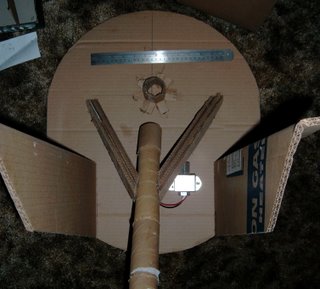
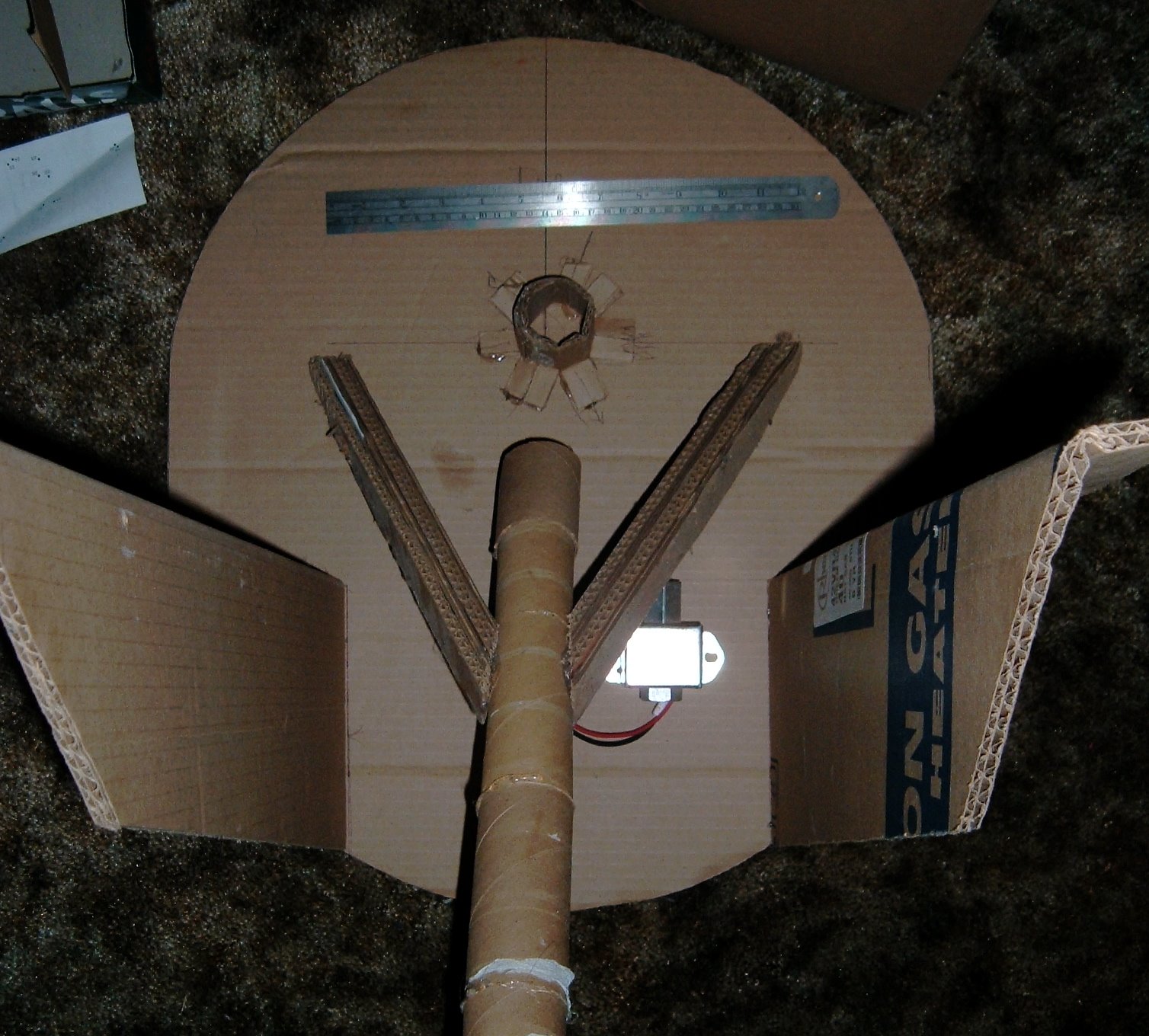
With a double wall cardboard box from the local recycling center, and some hot melt, the spatial relationships of the engine to the front of my fuselage are getting clearer. This design uses a "bed mount". The sides of the case are flattened, and aluminum angles are bolted through the walls of the case. Resilient "Barry Mounts" then bolt up to these "fingers, built up of extrusions and sheet. The reason I chose this airframe is that these mounting scheme doesn't care which way the flywheel faces. The prop hub on this airframe will be mounted on the flywheel end, the left in this image.


Some of the details. Hot melt glue is a great thing for this sort of quick and dirty assemblage.


The pole is centered on the #4 bearing with a cardboard "bushing". Nothing is glued to the pole, allowing it to be taken apart in a pretty tight space here in the corner of my front hall/workshop, and to position the engine relative to the airframe.


It's not too clear in this view, but most of the engine outboard of the case hangs out in the breeze in this design.

Now it's time to start playing around with the tubing bends, and seeing how it will all fit together, if it will.

Friday, June 08, 2007

VW Aero Engine Mockup


In order to work out the intake and exhaust, I've built a mockup out of a junk case, 2 junk heads, and some aluminum spacers. I've got it mounted to my engine stand, so I can flip it all around with relative ease. Below is my first cut at what the plumbing will look like:


Symmetry is the hobgoblin of the unimaginative. The objectives here were a crossover 4 into 2 into 1 exhaust, take carb heat off at least 2 cylinders, and have the sump accessible for oil changes. To save weight, the intakes will be fabricated out of aluminum bends from Burns Stainless, the exhaust will be mild steel, starting from a Great Plains U-Build kit, ceramic coated.

Update: I've decided I don't like the 1-4 exhaust running that close to the carb, so I'm going to try to run it in front of the intake.

Another Update: NONE of the exhaust scheme presented here worked at all, given the bed mount of my fuselage, so I've radically simplified the arrangement, so later posts.